
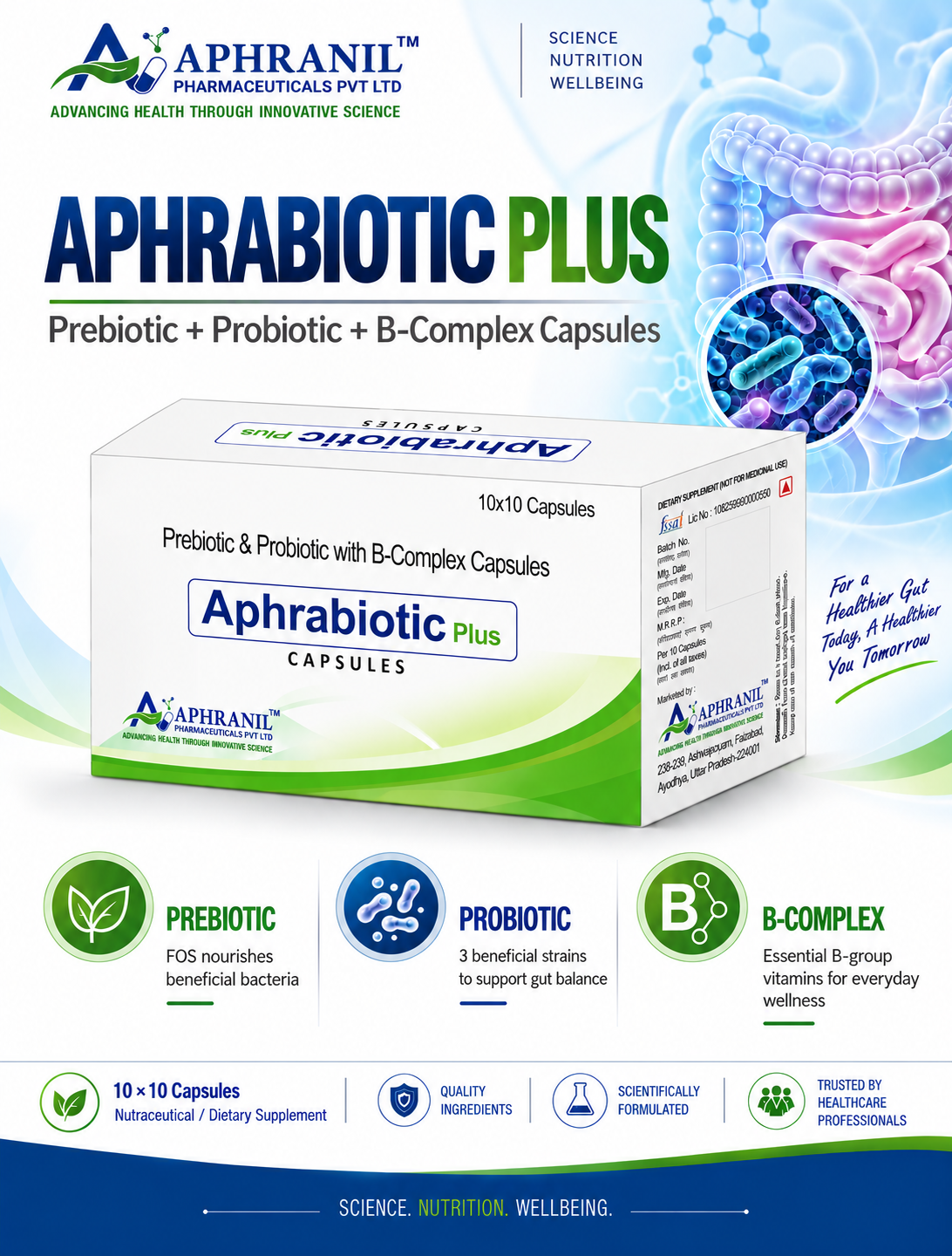
What Is Aphrabiotic Plus?
Aphrabiotic Plus is a dietary supplement/nutraceutical from Aphranil Pharmaceuticals Pvt. Ltd. It is formulated as Prebiotic & Probiotic with B-Complex Capsules.
The formulation combines three key components:
- FOS as a prebiotic
- A three-species probiotic blend
- B-complex vitamins
A prebiotic and a probiotic are related but distinct concepts. A prebiotic is a substrate that can be utilized by microorganisms, while probiotics are live microorganisms that, when administered in adequate amounts, can provide a health benefit to the host.
Scientific evidence for probiotics is not necessarily interchangeable between products. Effects can depend on the particular strain, dose, formulation, population and outcome being studied.
What Does Aphrabiotic Plus Contain?
Each capsule contains the following formulation:
Prebiotic
Fructooligosaccharides (FOS) — 300 mg
Probiotic Blend
- Lactobacillus acidophilus — 1 Billion CFU
- Lactobacillus rhamnosus — 1 Billion CFU
- Bifidobacterium longum — 1 Billion CFU
Total probiotic count: 3 Billion CFU per capsule
B-Complex Vitamins
- Vitamin B1 (Thiamine Mononitrate) — 1.4 mg
- Vitamin B2 (Riboflavin) — 1.6 mg
- Vitamin B3 (Niacinamide) — 18 mg
- Vitamin B5 (Calcium D-Pantothenate) — 5 mg
- Vitamin B6 (Pyridoxine HCl) — 1.9 mg
- Vitamin B7 (Biotin) — 40 mcg
- Vitamin B9 (Folic Acid) — 176.5 mcg
- Vitamin B12 (Cyanocobalamin) — 2.2 mcg
These are formulation quantities and should not be interpreted as an individualized dosage recommendation.
FOS Prebiotic — 300 mg
What Is FOS?
Fructooligosaccharides (FOS) are short-chain carbohydrates that can be fermented by microorganisms in the gastrointestinal tract.
FOS is studied as a prebiotic because it can serve as a substrate for certain microorganisms in the gut.
A 2022 systematic review and meta-analysis examined human studies of FOS supplementation. The analysis included 8 studies with 213 participants receiving FOS and 175 control participants. The researchers reported an increase in Bifidobacterium spp. during FOS supplementation.
The review also found that effects differed according to factors such as dose and duration. Some subgroup analyses showed greater effects with higher FOS doses and interventions lasting more than four weeks.
Important limitation
These findings represent research on FOS supplementation, not a clinical trial of Aphrabiotic Plus.
The doses used across the studies varied and included amounts higher than the 300 mg FOS per capsule contained in Aphrabiotic Plus. Therefore, the results cannot automatically be applied to the finished product.
Reference: Dou Y, et al. 2022. Nutrients. 14(16):3298. PMID: 36014803. DOI: 10.3390/nu14163298.
Probiotic Blend — 3 Billion CFU
Aphrabiotic Plus contains three probiotic species:
- Lactobacillus acidophilus
- Lactobacillus rhamnosus
- Bifidobacterium longum
Each is present at 1 Billion CFU per capsule, giving a total stated probiotic count of 3 Billion CFU per capsule.
CFU stands for colony-forming units, a commonly used measurement for viable microorganisms in probiotic products.
Lactobacillus acidophilus
Lactobacillus acidophilus is a bacterial species that has been extensively investigated in probiotic research.
A 2022 systematic review and meta-analysis evaluated 15 randomized controlled trials involving 1,765 children with acute gastroenteritis. The review found that evidence varied and that effects were not statistically significant in the subgroup where an individual L. acidophilus strain was administered alone.
This research demonstrates why probiotic evidence should be interpreted carefully. Results obtained from one strain, dose and population cannot automatically be transferred to another formulation.
The Aphrabiotic Plus formulation identifies the species L. acidophilus but does not provide a specific strain designation in the supplied formulation information.
Lactobacillus rhamnosus
Lactobacillus rhamnosus is another widely studied probiotic species.
A systematic review published in 2026 examined 51 randomized controlled trials involving L. rhamnosus in different research contexts. The authors described evidence across multiple settings while emphasizing differences between studies and the need for further research.
Importantly, L. rhamnosus is a species name rather than a complete strain designation.
Different strains belonging to the same species can have different biological characteristics and evidence profiles. Consequently, research involving a specific L. rhamnosus strain should not automatically be considered evidence for every product containing L. rhamnosus.
Bifidobacterium longum
Bifidobacterium longum is a bacterial species commonly studied in probiotic research.
A 2023 meta-analysis evaluated randomized controlled trials involving B. longum supplementation in infants. The review included 15 randomized controlled trials and assessed several outcomes related to infant health and development.
However, these studies involved infant populations and different probiotic preparations. Therefore, their findings should not be interpreted as clinical evidence for Aphrabiotic Plus.
Why Probiotic Strain Matters
One of the most important concepts in probiotic science is strain specificity.
The World Gastroenterology Organisation notes that probiotic effects are associated with particular strains or combinations and that probiotic dose can vary between products. There is therefore no single dose that can be universally applied to every probiotic preparation.
A systematic review and meta-analysis also found evidence that probiotic efficacy can be strain-specific and disease-specific.
This creates an important distinction:
Species evidence ≠ strain evidence ≠ finished-product evidence
For Aphrabiotic Plus, the supplied formulation identifies the three probiotic species but does not provide individual strain designations.
B-Complex Vitamins in Aphrabiotic Plus
Aphrabiotic Plus contains eight B-complex vitamins:
- Vitamin B1
- Vitamin B2
- Vitamin B3
- Vitamin B5
- Vitamin B6
- Biotin
- Folate
- Vitamin B12
B vitamins participate in numerous normal physiological processes, including energy metabolism, cellular metabolism, amino-acid metabolism and other biochemical reactions.
Vitamin B1 — Thiamine
Vitamin B1 is involved in energy metabolism and functions as a cofactor for enzymes involved in the metabolism of carbohydrates, amino acids and lipids.
Vitamin B2 — Riboflavin
Vitamin B2 forms the coenzymes FMN and FAD, which participate in cellular energy production and metabolic reactions.
Vitamin B3 — Niacin
Vitamin B3 contributes to the formation of NAD and NADP, which participate in numerous oxidation-reduction and metabolic reactions.
Vitamin B5 — Pantothenic Acid
Vitamin B5 is required for the synthesis of coenzyme A and is involved in fatty-acid and energy metabolism.
Vitamin B6
Vitamin B6 acts as a cofactor in more than 100 enzymatic reactions, particularly those involved in protein metabolism.
Vitamin B7 — Biotin
Biotin functions as a cofactor for enzymes involved in fatty-acid, glucose and amino-acid metabolism.
Vitamin B9 — Folate
Folate participates in one-carbon transfer reactions that are important for DNA and RNA synthesis and amino-acid metabolism.
Vitamin B12
Vitamin B12 acts as a cofactor for specific enzymes involved in processes including DNA synthesis and amino-acid metabolism.
These statements describe normal nutritional and physiological functions and should not be interpreted as disease-treatment claims.
Prebiotic vs Probiotic: What’s the Difference?
| Component | Prebiotic | Probiotic |
|---|---|---|
| Basic concept | A substance utilized by microorganisms | Live microorganisms |
| Aphrabiotic Plus component | FOS | L. acidophilus, L. rhamnosus, B. longum |
| Amount | 300 mg FOS | 3 Billion CFU total |
| Scientific concept | May provide a substrate for microorganisms | Provides specific live microorganisms |
| Evidence considerations | Depends on the substance, dose and formulation | Depends strongly on strain, dose, formulation and population |
Prebiotics and probiotics are therefore different but related concepts.
A prebiotic is not a microorganism. A probiotic is a live microorganism.
How Prebiotics and Probiotics Relate to the Gut Microbiome
The gastrointestinal tract contains a complex community of microorganisms known collectively as the gut microbiota.
Diet is one of the factors that can influence the composition and activity of the gut microbiome. Research has investigated relationships between dietary patterns, nutrients, dietary fibers, bioactive compounds and microbial communities.
However, the gut microbiome is complex, and a change in the abundance of one bacterial group does not automatically mean that overall microbiome health or diversity has improved.
A 2026 systematic review and meta-analysis of randomized controlled trials in healthy populations evaluated probiotic supplementation and gut microbiota diversity. The analysis did not find statistically significant effects on several commonly measured diversity indices and highlighted the importance of further strain- and formulation-specific research.
This is why probiotic research should be interpreted according to the exact microorganism, strain, dose, formulation, population and outcome studied.
What Does Current Clinical Research Say?
| Ingredient / Component | Evidence Type | Population | Main Finding | Limitation | Relevance to Aphrabiotic Plus |
|---|---|---|---|---|---|
| FOS | Systematic review & meta-analysis | Human studies | Increased Bifidobacterium spp. in FOS supplementation studies | Dose and duration varied | Ingredient-level evidence only |
| L. acidophilus | Systematic review & meta-analysis | 1,765 children | Evidence varied; individual-strain subgroup did not show statistically significant effect | Different population and strain context | Does not establish product efficacy |
| L. rhamnosus | Systematic review | 51 RCTs | Research has investigated multiple health outcomes | Effects vary by strain and context | Species-level evidence only |
| B. longum | Meta-analysis | Infants | Multiple outcomes investigated | Infant population and preparations varied | Does not directly establish product efficacy |
| Probiotics generally | Systematic review & meta-analysis | Healthy populations | No significant effect on several diversity indices | Different strains, doses and formulations | General background evidence |
| B vitamins | Nutritional research | General human nutrition | Important roles in normal metabolism | Physiological role does not establish product-specific clinical effects | Nutritional component |
What Aphrabiotic Plus Contains vs What Research Shows
This distinction is particularly important when communicating scientific information about probiotic products.
Product Formulation
Aphrabiotic Plus contains:
- FOS — 300 mg
- L. acidophilus — 1 Billion CFU
- L. rhamnosus — 1 Billion CFU
- B. longum — 1 Billion CFU
- Total probiotics — 3 Billion CFU
- Eight B-complex vitamins
These values are based on the supplied formulation information.
Published Scientific Evidence
Scientific research exists on FOS, probiotics, individual probiotic species and B vitamins.
However, research studies can use:
- different probiotic strains;
- different doses;
- different combinations;
- different formulations;
- different populations;
- different intervention durations; and
- different outcomes.
Therefore, ingredient-level evidence should not be presented as proof that the finished Aphrabiotic Plus product has demonstrated the same clinical outcome.
The individual ingredients/components have been studied in scientific research, but this should not be interpreted as evidence from a clinical trial of the finished Aphrabiotic Plus product itself.
How Aphrabiotic Plus Fits Into a Healthy Lifestyle
A dietary supplement should be considered as part of an overall healthy lifestyle rather than as a replacement for healthy habits.
Balanced Diet
A varied diet containing vegetables, fruits, whole grains, legumes, protein sources and other nutrient-rich foods provides a broad range of nutrients and dietary components.
Dietary Fiber
Adequate dietary fiber is an important part of overall nutrition and supports normal gastrointestinal function.
Hydration
Adequate fluid intake supports normal physiological processes.
Physical Activity
Regular physical activity is an important component of overall health and wellbeing.
Sleep
Adequate and consistent sleep supports normal physical and cognitive functions.
Responsible Supplement Use
Dietary supplements should be used according to their product labeling and appropriate professional guidance.
A supplement should not be considered a substitute for a balanced diet, healthy lifestyle or appropriate medical care.
Quick Answers About Aphrabiotic Plus
What is Aphrabiotic Plus?
Aphrabiotic Plus is a dietary supplement/nutraceutical from Aphranil Pharmaceuticals Pvt. Ltd. It is formulated as Prebiotic & Probiotic with B-Complex Capsules. Each capsule contains FOS, a three-species probiotic blend providing a total of 3 Billion CFU, and eight B-complex vitamins.
What does Aphrabiotic Plus contain?
Aphrabiotic Plus contains FOS 300 mg, Lactobacillus acidophilus 1 Billion CFU, Lactobacillus rhamnosus 1 Billion CFU and Bifidobacterium longum 1 Billion CFU. It also contains vitamins B1, B2, B3, B5, B6, B7, B9 and B12.
Is Aphrabiotic Plus a probiotic?
Aphrabiotic Plus contains probiotics as one part of its formulation. It also contains FOS as a prebiotic and eight B-complex vitamins. Therefore, the product is more accurately described according to its complete formulation: Prebiotic & Probiotic with B-Complex Capsules.
What is the role of FOS in Aphrabiotic Plus?
FOS is included as the prebiotic component. Human research has investigated FOS supplementation and its effects on gut microbiota, including changes in Bifidobacterium abundance. However, research findings depend on dose, duration and study design and should not automatically be applied to the finished product.
How many probiotic CFUs are in Aphrabiotic Plus?
Aphrabiotic Plus contains 3 Billion CFU per capsule. This consists of 1 Billion CFU each of Lactobacillus acidophilus, Lactobacillus rhamnosus and Bifidobacterium longum.
Which probiotic microorganisms are included?
The formulation includes Lactobacillus acidophilus, Lactobacillus rhamnosus and Bifidobacterium longum. The supplied product information does not provide individual strain designations.
What is the role of B-complex vitamins?
B-complex vitamins participate in normal physiological processes such as energy metabolism, cellular metabolism, amino-acid metabolism and other biochemical reactions. Each B vitamin has its own specific biological functions.
What is the difference between a prebiotic and a probiotic?
A prebiotic is a substance that can be utilized by microorganisms, while a probiotic is a live microorganism that may provide a health benefit when administered in adequate amounts. FOS is the prebiotic component of Aphrabiotic Plus, while the three named bacterial species make up its probiotic component.
How does FOS differ from probiotics?
FOS is not a microorganism. It is a carbohydrate used as a prebiotic component. Probiotics are live microorganisms. Therefore, FOS and probiotics represent different components with different biological concepts.
Is there clinical research on the ingredients in Aphrabiotic Plus?
Yes. Scientific research exists for FOS, individual probiotic species and B-complex vitamins. However, these studies involve different doses, strains, populations and formulations. They should therefore be considered ingredient-level or category-level evidence rather than clinical trials of Aphrabiotic Plus.
Is Aphrabiotic Plus a medicine?
Aphrabiotic Plus is presented in the supplied information as a dietary supplement/nutraceutical. It should not be described as a medicine or as a treatment for a disease unless appropriate product-specific evidence and regulatory authorization support such a claim.
Can evidence for one probiotic strain be applied to another product?
Not automatically. Probiotic effects can be strain-, dose-, formulation- and population-specific. Research involving a particular strain should not automatically be generalized to every product containing the same species.
Can Aphrabiotic Plus replace a balanced diet?
No. A dietary supplement should not replace a balanced and varied diet.
Who should consult a healthcare professional before using supplements?
People who are pregnant or breastfeeding, have a medical condition, take medicines, are immunocompromised, or experience persistent or unexplained gastrointestinal symptoms should consult an appropriate healthcare professional before using a dietary supplement.
Safety and Responsible Use
Dietary supplements should be used responsibly and according to the product label and appropriate professional guidance.
Individuals should consider consulting an appropriate healthcare professional before using supplements if they:
- have an existing medical condition;
- are pregnant or breastfeeding;
- take prescription or other medicines;
- are immunocompromised;
- have persistent gastrointestinal symptoms; or
- have concerns regarding suitability or possible interactions.
Probiotic products can differ in microorganism identity, strain, potency, formulation and storage requirements. The World Gastroenterology Organisation highlights the importance of appropriate identification and quality considerations when evaluating probiotic products.
This article is intended for educational and informational purposes and does not provide individualized medical advice.
Aphrabiotic Plus Formulation Summary
Aphrabiotic Plus brings together three formulation components:
FOS Prebiotic — 300 mg
A prebiotic component investigated in human research for its interaction with the gut microbiota.
Probiotic Blend — 3 Billion CFU
A combination of Lactobacillus acidophilus, Lactobacillus rhamnosus and Bifidobacterium longum.
B-Complex Nutrition
Eight B vitamins contributing to normal nutritional and physiological functions.
Together, these components define the formulation of Aphrabiotic Plus: Prebiotic & Probiotic with B-Complex Capsules.
Conclusion
Aphrabiotic Plus is a dietary supplement/nutraceutical from Aphranil Pharmaceuticals Pvt. Ltd., formulated as Prebiotic & Probiotic with B-Complex Capsules.
Each capsule contains 300 mg FOS, a three-species probiotic blend providing 3 Billion CFU, and eight B-complex vitamins.
Scientific research has investigated FOS, probiotics, individual probiotic species, gut microbiota and B-complex vitamins. However, probiotic evidence is strongly influenced by factors such as strain, dose, formulation, population and study outcome.
For this reason, research on an individual ingredient or probiotic species should not automatically be interpreted as clinical evidence for the finished Aphrabiotic Plus product.
No product-specific clinical trial evidence for Aphrabiotic Plus was identified in the sources reviewed.
Aphrabiotic Plus should therefore be understood according to its actual formulation: Prebiotic + Probiotic + B-Complex, presented as a dietary supplement/nutraceutical.
Scientific References
1. Dou Y, Yu X, Luo Y, et al. (2022)
Effect of Fructooligosaccharides Supplementation on the Gut Microbiota in Human: A Systematic Review and Meta-Analysis.
Nutrients. 2022;14(16):3298.
PMID: 36014803
DOI: 10.3390/nu14163298
2. World Gastroenterology Organisation (2023)
Probiotics and Prebiotics Global Guidelines.
World Gastroenterology Organisation.
3. McFarland LV, Evans CT, Goldstein EJC. (2018)
Strain-Specificity and Disease-Specificity of Probiotic Efficacy: A Systematic Review and Meta-Analysis.
Frontiers in Medicine. 2018;5:124.
PMID: 29868585
DOI: 10.3389/fmed.2018.00124
4. Cheng H, Ma Y, Liu X, et al. (2022)
A Systematic Review and Meta-Analysis: Lactobacillus acidophilus for Treating Acute Gastroenteritis in Children.
Nutrients. 2022;14(3):682.
PMID: 35277042
DOI: 10.3390/nu14030682
5. Yang Y, Sui J, Liao W, et al. (2026)
Clinical Evidence on the Health Benefits and Safety of Probiotic Lacticaseibacillus rhamnosus: A Systematic Review.
Probiotics and Antimicrobial Proteins. 2026.
PMID: 40643866
DOI: 10.1007/s12602-025-10646-8
6. Guo H, Fan M, Hou T, et al. (2023)
Efficacy and Safety of Bifidobacterium longum Supplementation in Infants: A Meta-Analysis of Randomized Controlled Trials.
Foods. 2023;12(24):4451.
PMID: 38137255
DOI: 10.3390/foods12244451
7. Éliás AJ, Földvári-Nagy KC, Al-Gharati YZ, et al. (2026)
Effect of probiotic supplementation on the gut microbiota diversity in healthy populations: a systematic review and meta-analysis of randomised controlled trials.
BMC Medicine. 2026;24:71.
PMID: 41495831
DOI: 10.1186/s12916-025-04602-0
8. NIH Office of Dietary Supplements
Vitamin and Mineral Supplement Fact Sheets.
National Institutes of Health.
Aphrabiotic Plus capsules combines the benefits of prebiotics and probiotics with essential B-complex vitamins to support gastrointestinal health and overall well-being. Recent studies, including a meta-analysis on Bifidobacterium longum supplementation in infants, highlight the efficacy and safety of probiotics in enhancing gut microbiota. Additionally, systematic reviews show that probiotic supplementation can significantly improve gut microbiota diversity in healthy populations. This formulation is designed to promote optimal digestive health through a balanced approach to microbiome support.